

 Nabila Marzuk Shanta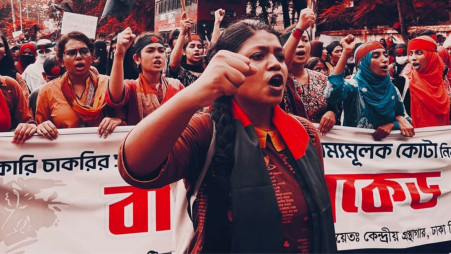
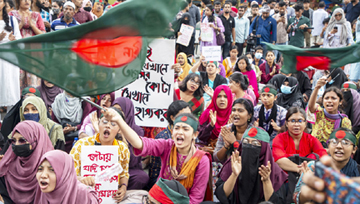
During Bangladesh’s July 2024 mass uprising, women—especially female students—played a fearless and visible role that will be etched into the nation’s history. They marched, spoke, organized, documented, and resisted. Yet alongside the physical struggle on the streets unfolded a darker, less visible battle: a coordinated wave of digital violence targeting women’s voices.
The movement was not only fought on the roads; it was a psychological war waged online. As women broke barricades and stepped forward in public spaces, a parallel force mobilized in cyberspace to push them back. Alongside bullets and batons, women faced what can only be described as “virtual bullets”—relentless online abuse, threats, character assassination, and sexualized harassment.
The wounds of the street are visible. The wounds of the digital space are not. Yet many women emerged from the movement carrying deep psychological scars. Despite family pressure, social stigma, and fear of public shaming, they did not retreat—offering a rare and powerful example of resistance in a deeply patriarchal society.
In such societies, silencing women often follows a familiar script: question her morality, her character, her “honor.” During the student movement, this tactic was deployed with calculated precision. The goal was clear—to remove women from the movement and to warn others of the cost of speaking out.
Cyberspace as a Battlefield
Digital media today is no longer merely a platform for communication. It has become a space of power, resistance, and violence—a parallel battlefield. Bangladesh’s recent student movement exposed this reality with brutal clarity. Just as protesters faced police batons and water cannons on the streets, women faced an invisible but equally devastating assault online.
This violence did not emerge overnight. For years, social media in Bangladesh has cultivated a culture of silencing women. During the uprising, that culture reached its most extreme form. Female students, journalists, activists, and even ordinary citizens expressing opinions became targets—identity offered no protection.
A young journalist, Fariha Rahman (name changed), shared a video documenting police conduct during the protests. What followed was a coordinated digital attack: manipulated images of her circulated online, her family’s address and phone number were leaked, and she received hundreds of messages daily—threats, sexual slurs, and intimidation. Eventually, the abuse endangered her professional work. For safety, she withdrew from social media—the very space she had used to tell the truth.
Another university student, Maya Akter (name changed), used Twitter to share protest updates. Within days, fake accounts accused her of participating in “anti-state conspiracies.” The disinformation campaign shattered her mental health. Her family urged her to “stay silent.” She, too, disappeared from digital spaces.
Public Shaming as Digital Lynching
A recent incident in Cox’s Bazar offers a chilling example of how digital violence operates beyond political movements. A video went viral showing a woman being publicly humiliated—forced to do squats as punishment for wearing “Western clothing.” The caption labeled her a prostitute. No evidence. No accountability.
Within hours, millions witnessed her dignity auctioned in the digital public square. This was not just a video—it was a digital lynching, reflecting society’s obsession with controlling women’s bodies, clothing, and freedom.
A High-Profile Target
The phenomenon is not limited to anonymous women. Dr. Tasnim Jara, a prominent public figure, faced severe online attacks after clearly stating her political position—particularly after distancing herself from certain alliances. The response was immediate and vicious.
Her arguments were ignored. Instead, her identity as a woman became the target. Abuse, character assassination, threats, and ridicule followed. Even her family was dragged into the harassment. Social media transformed into a “free trial court”—where verdicts are delivered without evidence, ethics, or empathy.
Her case underscores a harsh reality: for women in Bangladesh, taking a political or social stance often means placing both oneself and one’s family at risk.
The Cost of Silence
The impact of such digital violence does not end online. Silence, withdrawal, anxiety, loss of confidence, depression—these are its tangible outcomes. Families often pressure victims to stay quiet to “protect honor.” In some past cases, prolonged online harassment has even contributed to suicide—an alarming reminder of what unchecked digital abuse can cost.
And yet, women have not surrendered.
They have created informal support systems—private groups, encrypted chats, shared warnings, collective reporting. They have built digital shields out of solidarity.
Unfinished Justice
The 2024 uprising succeeded in many ways. But the wounds women carry from the digital battlefield remain largely unacknowledged. Building a truly equitable Bangladesh requires ensuring safety and dignity not only on the streets but also online.
The laws exist—but their effectiveness is questionable. Cybercrime and digital security regulations are not victim-friendly. Legal processes are slow, complex, and often retraumatizing. Frequently, the victim herself is scrutinized. As a result, most women choose silence as a survival strategy.
The July 2024 movement taught us this: freedom is not only about reclaiming streets—it is about securing fearless expression in digital spaces. The women who marched while enduring obscene abuse from behind screens deserve recognition, justice, and protection.
Every day, women continue to fight this digital war—some visibly, others by retreating into silence. The stronger women’s voices grow online, the more brutal the backlash becomes.
The question remains: Is the state, are digital platforms, and is society truly prepared to confront this violence?
Author Bio
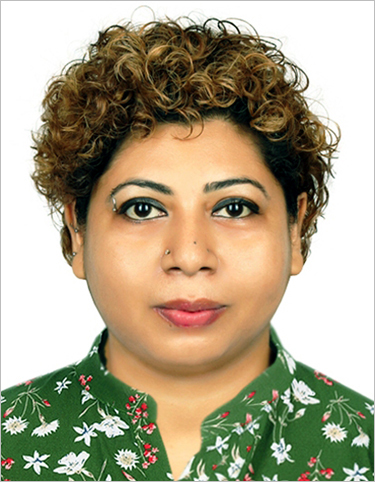
Nabila Marzuk Shanta is a senior television producer, documentary filmmaker, and media researcher from Bangladesh with over twelve years of experience in broadcast journalism and visual storytelling. She has worked with leading national television networks including Channel i, Channel 24, Jamuna TV, and Nagorik Television.
Her documentary project Hip-Hop and Hope: The Dhaka Way received the European Documentary Award and the Beyond Borders Scotland Award, earning international recognition for its exploration of youth, identity, and resistance.
Nabila’s work focuses on gender, digital media, and social justice. She has conducted workshops in journalism and media studies, published research-based articles, and remains actively involved in media advocacy and storytelling. She currently serves as a Senior Producer at Nagorik Television and is pursuing advanced research on digital gender-based violence in South Asia.
Email: nabilamarzuk@gmail.com









 info@amadermanchitra.news